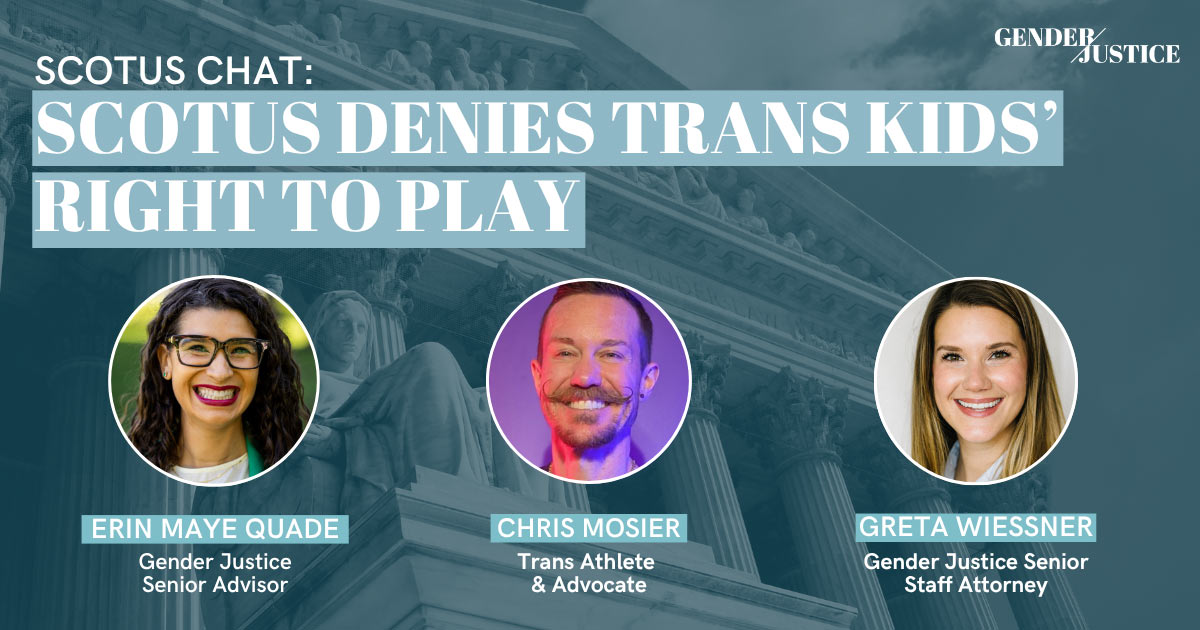
On June 30, 2026, the U.S. Supreme Court issued a devastating ruling in West Virginia v. B.P.J. and Little v. Hecox, leaving transgender girls behind. The Court upheld discriminatory state laws that bar transgender girls from participating in girls’ school sports — upholding discriminatory bans in 27 states, including North Dakota, West Virginia, and Idaho. While the ruling does not require every state to follow suit and enact discriminatory laws, it was a painful blow to kids who simply want to be kids and play with their friends.
In Minnesota, where the Minnesota Human Rights Act protects transgender individuals from discrimination, trans-inclusive laws will remain in place and we will defend them fiercely.
Watch our SCOTUS Chat to learn more, or scroll to read on for what you need to know.
Trans Youth in Minnesota Still Have the Right to Play
Thanks to the determination and tireless work of advocates and lawmakers, transgender and nonbinary kids in Minnesota can continue to play alongside their teammates and be treated with the dignity they deserve.
The state’s trans-inclusive policies — grounded in state civil rights law and affirmed by the Minnesota Supreme Court’s unanimous ruling last year in Cooper v. USA Powerlifting and the 2021 Court of Appeals ruling in N.H. v. Anoka-Hennepin School District — remain in full effect. However, a separate federal lawsuit is currently underway challenging whether Minnesota’s inclusive policies themselves violate Title IX — a case that could pose a more direct long-term threat to Minnesota’s inclusive laws than the Court’s recent decision.
The Ruling Undermines Title IX’s Protections Against Sex Discrimination
Title IX, the landmark 1972 civil rights law prohibiting sex-based discrimination in education programs that receive federal funding, was designed to guarantee equal educational opportunity. However, the Court concluded that bans against transgender girls playing sports with their peers do not violate Title IX.
Title IX has never required schools to exclude transgender students. In fact, many courts around the country have found that Title IX protects trans students from discrimination. Extremists are attempting to rewrite Title IX by redefining “sex” in ways that narrow who counts, who qualifies for protection, and who belongs. Reframing the law as a justification for discrimination alters its purpose and puts all students at risk.
The Fight Continues in North Dakota
North Dakota bans trans girls from playing on girl’s sports teams in K-12 schools and public colleges. The U.S. Supreme Court’s ruling allows North Dakota’s ban to stand under Federal law. This narrows avenues to fight the ban in courts. But North Dakotans still have a voice in statehouses, school boards, city councils, and through community organizing.
For North Dakota families, the fight isn’t over. Because no one should be excluded from participating in sports because of who they are.
This Is Bigger than Sports. It’s About Dismantling Equality
While cases like West Virginia v. B.P.J. and Little v. Hecox may be framed as “debates” about school sports, the stakes are much higher. When the law empowers schools and states to define the “right” type of girl, every girl becomes subject to scrutiny, harassment, and intimidation. Narrowing “sex” to a rigid, state‑enforced definition opens the door for broader gender-based discrimination that impacts all kids.
Title IX works because it recognizes that discrimination based on sex often shows up through stereotypes: how women’s bodies should look, how women should behave, and who is seen as credible or deserving of protection.
This ruling was never just about student athletes or school policies. It’s about who is seen as credible, deserving of protection, and worthy of equal rights. We will keep fighting – in the courts and in every community – because every kid deserves the chance to play and all transgender people deserve to live freely, safely, and with dignity.
How to Get Involved
- Attend the upcoming Special Edition of Trans Equity Training on Countering Anti- Trans Narratives to learn how to respond to fearmongering about trans existence in traditionally gender-separated spaces such as sports, bathrooms, and prisons.
- Sign our open letter standing with transgender youth in North Dakota, and the families, doctors, and communities who love and care for them.
- Explore best practices for schools and educators to support trans and non-binary students.
- Learn more about Title IX – designed to ensure equal opportunity, full participation, and protection from discrimination – and how it’s being twisted into a tool for exclusion.
Recent Commentary
- White Christian Nationalism is Coming for Our Civil Rights
- Open Letter to North Dakota Leaders: We Stand With Trans Youth
- Case Update: Fighting for Workers Rights at the Minnesota Supreme Court
- Spring 2026 Newsletter
- Impact on Protections Against Conversion Therapy in Minnesota and North Dakota
- The Title IX Fight Isn’t Just About Sports. It’s About Civil Rights.
- SCOTUS Hears Trans Sports Cases
- How Schools and Educators Can Step Up for Trans Youth
- Three Things to Know About the Landmark Cooper v. USA Powerlifting Win
- Why the ERA Can’t Wait: Voices from the Minnesotans for Equal Rights Coalition
Learn more about the topics on this page
Related Content
Open Letter to North Dakota Leaders: We Stand With Trans Youth
In light of the North Dakota Supreme Court's decision in T.D. v. Wrigley, upholding the state's cruel ban on gender-affirming care for trans youth, over 300 organizations and individuals signed an open letter urging state leaders to stand up for trans youth's right to thrive.

Case Update: Fighting for Workers Rights at the Minnesota Supreme Court
In Minnesota, and across the country, personal religious beliefs are increasingly being weaponized to weaken people’s civil rights — threatening their ability to participate in public life, get the health care they need, and keep their jobs and livelihoods.

Spring 2026 Newsletter
From bringing a gender justice lens to the ICE OUT movement, to fighting for trans equity in the courts and our communities, here’s what we’re accomplishing together — and what’s to come.

Milestones of Progress
Our organization has celebrated some big wins over the years and we continue to grow in the ways we harness strategic impact litigation, legislative advocacy, and education to push the law forward when it comes to gender equality. Check out what we’ve accomplished, together.