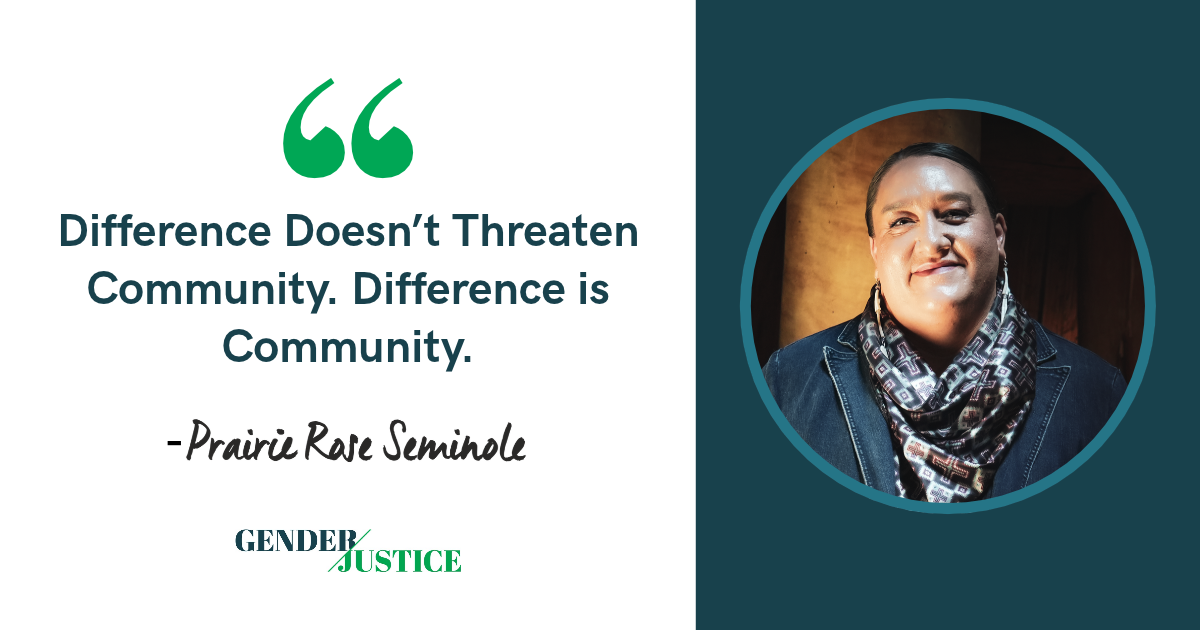
Reflections from Prairie Rose Seminole, Gender Justice Board Chair
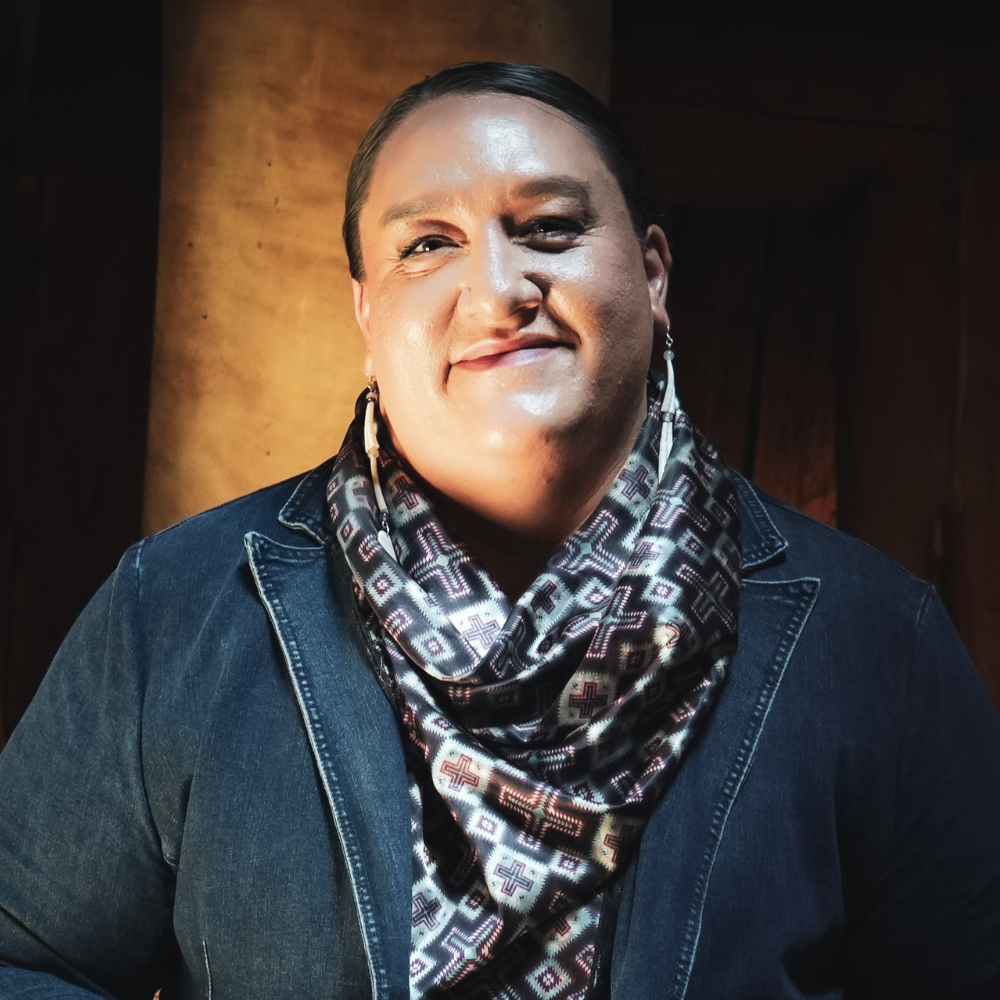 Knowing your history provides a particular clarity that comes when being descended from people whose identities were once declared illegal, whose families were separated, whose ways of being were erased. You learn to recognize when someone decides they have the power to define who you are, and whose rights are protected.
I am from North Dakota and a citizen of the Three Affiliated Tribes. I grew up in a multicultural home, my mother from a German from Russia farming family; my father Northern Cheyenne, Dakota, and Arikara. I was raised with the understanding that we are never truly alone as we carry our ancestors, our responsibilities, and the generations still waiting for us into life. Growing up, I was not taught leadership as domination, but as service. That power carries an obligation to the community around you, to those who came before, to those yet to come, and to the land that sustains us all. This is a very different starting point from authoritarianism.
Gender authoritarianism is ultimately about control. Control of bodies, identities, families, relationships, language, and the stories we are allowed to tell about ourselves. For me, there is a profound Indigenous resonance in that.
Colonization brought systems of classification designed to tell us who we were. Governments decided who was Indian enough. Institutions decided which children belong with their families. Boarding schools decided what language a child could speak, what they could wear, and what parts of themselves to surrender in order to survive. Underneath it all lies one assumption: Someone else gets to define you.
So when I hear political movements insist there is only one legitimate way to understand gender, as states write that insistence into law and strip trans people of protections, care, and recognition, I recognize more than a disagreement over terminology. I recognize a system trying to turn complexity into conformity.
When we refuse to let the government dictate which identities are legitimate, we are protecting something much larger than policy: We are protecting the idea that government exists to serve people.
My understanding of gender is informed by a worldview where relationships come before rigid categorization, and by Indigenous teachings that were never a single story or meant to fit inside colonized categories. What we are witnessing today is not one fight, but many: bans on gender-affirming care, abortion restrictions, laws policing which bathroom, sport, or classroom a child belongs in. What connects them is a government claiming that those decisions were never ours to make. If we accept that premise, there is no guarantee that the boundaries of who is considered acceptable will remain where they are.
That’s why Gender Justice’s work in North Dakota and Minnesota matters. Years spent working in North Dakota have shown me that our communities are far more complicated than our political labels. I have sat with people whose politics differ and still found shared commitments to family, community, fairness, and taking care of one another. Those relationships matter. In fact, I think they may be one of our greatest sources of power.
I won’t pretend that what is happening isn’t frightening or that we won’t lose some battles. Justice has never moved in a straight line, but I come from a people who survived policies meant to erase us. From women who carried their families through enormous loss. From a tradition that understands caring for the next generation is not separate from justice; It’s why we do the work.
There will come a time when we will look back and ask what we did when our government began attacking the rights of trans people and using fear as a political tool. I want our answer to be clear: We stood with our relatives, we protected our communities, and we refused to let fear define who belongs.
That is what gender justice means to me: building a society mature enough to understand that difference doesn’t threaten community. Difference is community.
Recent Commentary
- Fall 2026 Newsletter
- White Christian Nationalism is Coming for Our Civil Rights
- Open Letter to North Dakota Leaders: We Stand With Trans Youth
- Case Update: Fighting for Workers Rights at the Minnesota Supreme Court
- SCOTUS Ruled Against Trans Kids. What’s Next in the Fight for Every Kid’s Right to Play
- Spring 2026 Newsletter
- Impact on Protections Against Conversion Therapy in Minnesota and North Dakota
- The Title IX Fight Isn’t Just About Sports. It’s About Civil Rights.
- SCOTUS Hears Trans Sports Cases
- How Schools and Educators Can Step Up for Trans Youth
Learn more about the topics on this page
Related Content
Fall 2026 Newsletter
Digging into a year of resilience, joy, and resistance in the face of gender authoritarianism.
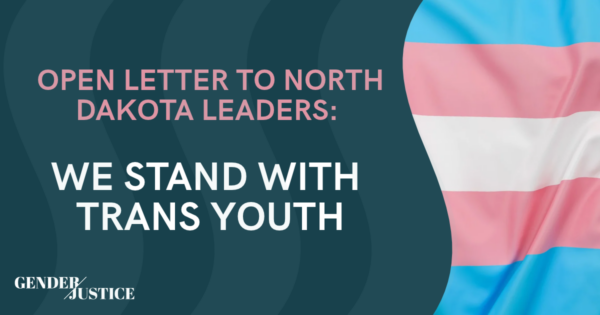
Open Letter to North Dakota Leaders: We Stand With Trans Youth
In light of the North Dakota Supreme Court's decision in T.D. v. Wrigley, upholding the state's cruel ban on gender-affirming care for trans youth, over 300 organizations and individuals signed an open letter urging state leaders to stand up for trans youth's right to thrive.
Case Update: Fighting for Workers Rights at the Minnesota Supreme Court
In Minnesota, and across the country, personal religious beliefs are increasingly being weaponized to weaken people’s civil rights — threatening their ability to participate in public life, get the health care they need, and keep their jobs and livelihoods.

Milestones of Progress
Our organization has celebrated some big wins over the years and we continue to grow in the ways we harness strategic impact litigation, legislative advocacy, and education to push the law forward when it comes to gender equality. Check out what we’ve accomplished, together.